Frozen Outdoor Faucet: Hidden Damage You Won't See Until Spring
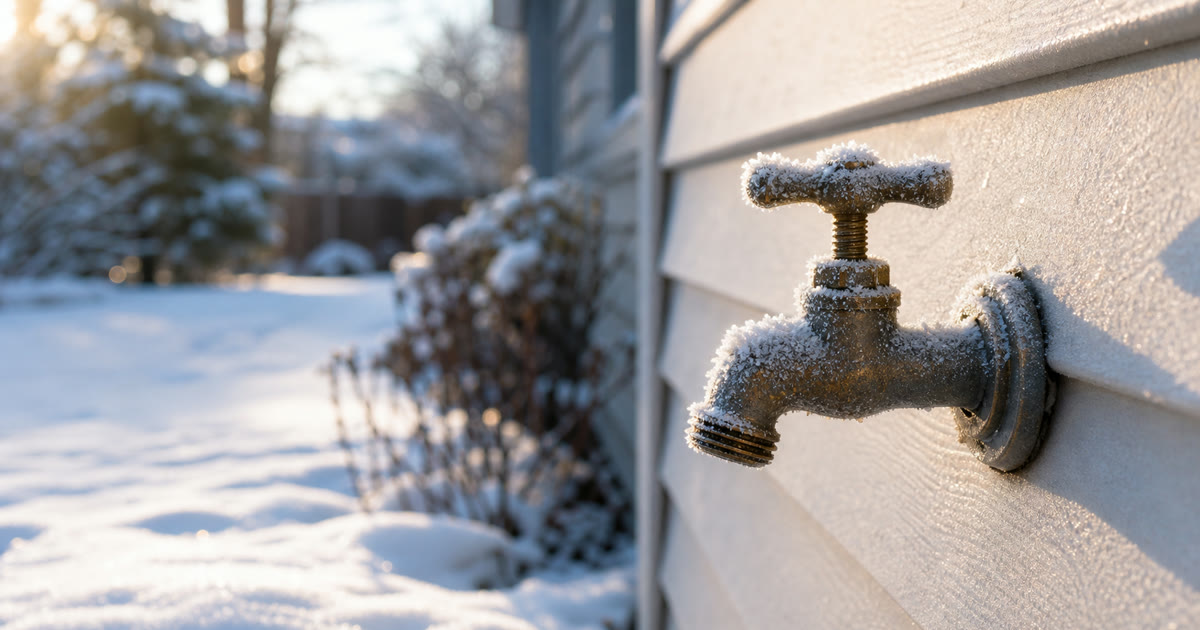
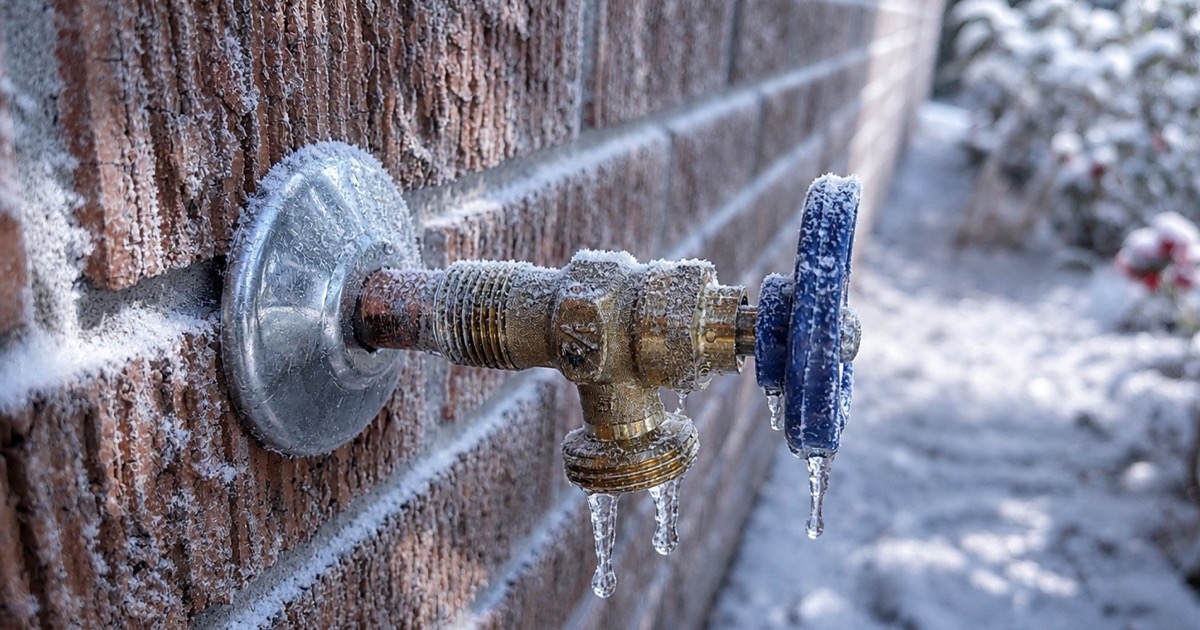
The frustrating thing about a frozen outdoor faucet isn't the ice you see — it's the crack you don't. Every spring, Calgary homeowners turn on the garden hose for the first time and discover water spraying inside a wall, dripping through a basement ceiling, or pouring from a hairline split in the spigot body. The damage happened months ago; the leak just waited for a thaw.
Here's exactly what happens when an outdoor faucet freezes, what it costs to fix at each stage, and why those five minutes of fall prep matter more than you think.
The freeze-damage chain: what's happening inside your wall
Water is one of the few substances that expands when it freezes — about 9% by volume, but with extraordinary force. Ice can generate over 2,000 psi of pressure inside a pipe, far more than copper or brass can withstand.
Here's how a single forgotten garden hose turns into a basement repair:
Stage 1: Water gets trapped
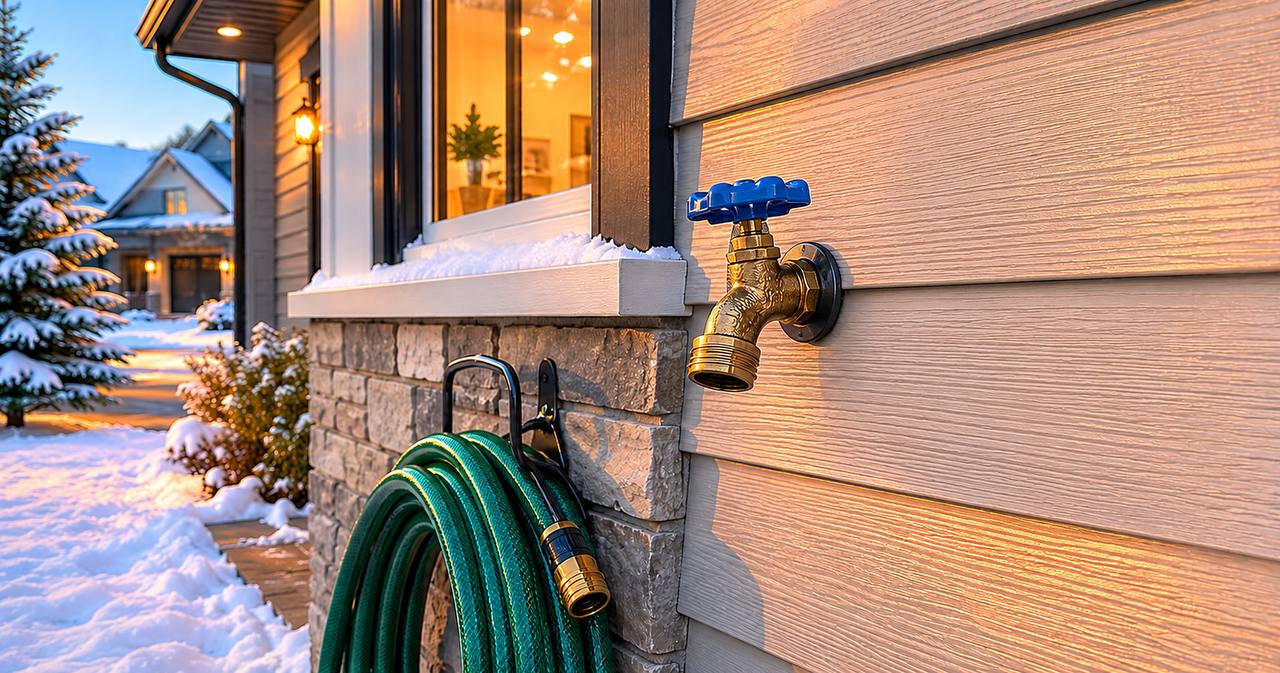
An outdoor faucet that's properly winterized has its indoor shut-off closed and the outdoor spigot left open — the line is empty. But leave a hose connected, a spray nozzle on, or a splitter attached, and water stays in the faucet body. Even a closed shut-off valve can let a few tablespoons of water sit in the fixture.
Stage 2: The freeze hits
When Calgary temperatures drop below zero — and they can hit –30°C or worse — the trapped water freezes. Ice forms first at the spigot opening (exposed to cold air) and works its way back into the pipe. As the ice plug grows, it has nowhere to expand except into the pipe walls.
Stage 3: The split (that you can't see)
Copper pipe doesn't always burst dramatically. More often, it develops a longitudinal split — a hairline crack along the length of the pipe. The ice plug fills the crack completely, so no water leaks all winter. You see nothing, hear nothing, and assume everything is fine.
The split is almost never at the spigot tip — it's usually 6 to 12 inches inside the wall, right where the pipe passes through the foundation or rim joist. That's the coldest point in the line.
Stage 4: Spring thaw reveals the damage
When the ice finally melts in April or May, the crack opens. The moment you turn on the shut-off valve — or the outdoor faucet itself — water pours through the split. Where that water goes depends on where the crack is:
- Split inside the wall cavity: water runs down inside the wall, soaks the bottom plate, and spreads across the subfloor. You notice it when the basement ceiling shows a water stain or drywall starts bubbling.
- Split at the spigot body: water sprays outward and drips down the exterior siding. Visible, but still a repair.
- Split behind the shut-off valve: this is the worst case. Water sprays inside the basement every time you use any fixture on that branch. Now you're cutting drywall.
What each level of damage costs in Calgary
Here's a realistic breakdown — these are typical Calgary service call figures, not worst-case:
| Damage | Typical repair | Ballpark cost |
|---|---|---|
| Cracked spigot body (outside only) | Replace hose bib | $150–250 |
| Split pipe inside wall, accessible from basement | Cut and solder new pipe section + patch small drywall hole | $400–800 |
| Split pipe in finished ceiling | Drywall cut, pipe repair, insulation replacement, re-drywall + paint | $1,200–2,500+ |
| Flooded finished basement (carpet, drywall, baseboards) | Full water mitigation + rebuild | $4,000–8,000+ |
The jump from "cracked spigot" to "flooded basement" is almost entirely about whether you turn the shut-off back on without testing. A slow five-minute test (described below) is the difference between a $200 faucet swap and an insurance claim.
Calgary's climate makes this worse
A few local realities that stack the odds against your outdoor faucet:
Freeze-thaw cycles. Calgary doesn't stay frozen all winter. A chinook can push temperatures to +10°C in January, partially thawing ice inside the pipe, only for a cold snap to refreeze it 48 hours later. Every cycle stresses the metal further — a phenomenon called fatigue cracking that can fail a pipe even if it survived previous winters.
North-facing walls. Homes where the outdoor faucet is on the north or east side of the house get no direct winter sun. The pipe stays cold even during warm spells. These are the most common freeze victims in Calgary.
Older neighbourhoods. Inglewood, Kensington, Mount Pleasant, Bowness — older homes often have standard (non-frost-free) spigots and shut-off valves that haven't been turned in years. If the shut-off is seized, the line can't be drained, and it's a matter of time.
The safe spring test: five minutes that saves thousands
Before you hook up the garden hose this spring, do this test. You need two people: one inside and one outside.
- Find the indoor shut-off for that outdoor line (usually in the basement near where the pipe exits the wall). Don't open it yet.
- Person inside: watch the pipe and the wall penetration with a flashlight.
- Person outside: turn the outdoor faucet fully on. It'll sputter air first — that's normal, the line was drained.
- Now person inside: slowly open the shut-off valve halfway.
- Watch for 60 seconds. Look for water beads, drips, hissing, or damp spots on the pipe, at the wall penetration, or on the floor below.
- If you see ANY water inside — shut the valve immediately. That's a split pipe. Leave it off and call for repair.
- If everything is dry and water flows normally outside, you're good.
Run this test every spring. Five minutes, two people, no tools.
When it's a faucet fix and when it's a plumber
At YOFF we handle outdoor faucet work: frozen spigot replacement, seized shut-off valve repair, frost-free bib installation. But if the split pipe is inside the wall and requires opening the wall cavity to re-solder plumbing lines, that crosses into licensed plumber territory — and we'll tell you straight. No upselling, no pretending.
The best outcome? You never need us for this. Disconnect the hose every October, shut off the indoor valve, drain the line — and your outdoor faucet will be fine. But if you're reading this because you already heard water dripping where it shouldn't, give us a call. We'll check it out, tell you honestly what you're looking at, and fix it if it's in our scope — No Fix, No Fee.
Rather have YOFF handle it?
We cover faucets and more across Calgary and nearby communities — booked fast, done right. No Fix — No Fee.