AC Startup Guide Calgary: Prep Your Cooling Before the Heat
Every June in Calgary, the same thing happens: the thermostat hits 28°C for the first time, someone flips the AC switch, and either nothing happens — or worse, a musty smell fills the house. After sitting dormant for eight months through winter and a dusty spring, your air conditioner needs more than just a button press. Half an hour of prep now beats a sweaty night waiting for a repair tech in July.
Here's a step-by-step AC startup checklist any homeowner can tackle — and when to call our technician instead of wrestling with it alone.
Why Calgary's climate is tough on air conditioners
Air conditioners here don't get the gentle ramp-up that units in Toronto or Vancouver do. They sit idle from October through May while the outdoor condenser endures chinook slush, driveway gravel kicked up by snowplows, and spring cottonwood fluff that coats everything in sight — especially in riverside neighbourhoods like Parkdale and Inglewood.
By mid-June, dry, dusty air has packed the outdoor coils with a layer of grime that cuts cooling efficiency. Add in a plugged condensate drain line from months of disuse, and you've got a recipe for a unit that's working twice as hard and cooling half as well. In older homes — think Haysboro, Acadia, or Brentwood, where AC units may be 10–15 years old and bolted onto a furnace from the 2000s — this neglect can turn a skipped maintenance step into an expensive service call.
What happens if you skip AC prep
The damage chain is straightforward:
- Dirty filter forces the blower to work harder. Airflow drops, indoor coils get too cold, and they ice up. In dry prairie air, that ice melts fast — and the water overwhelms the drip pan.
- A clogged condensate drain backs up. Water collects in the drip pan underneath the furnace and overflows onto the basement floor — the last place you want extra moisture.
- Grime-coated outdoor coils overheat the compressor. The unit runs longer to hit the set temperature, driving up your ENMAX bill during peak summer demand.
- Start-stop cycling wears out the capacitor. The most common "AC won't turn on" call — and it often traces back to a unit fighting through a dirty filter and clogged coils.
None of this is dramatic. It accumulates over a few summers until the unit gives up on the hottest day of the year.
Step 1: Kill the power (30 seconds)
Before touching anything: find the breaker for your AC in the electrical panel — it's usually a double-pole breaker labeled "AC" or "Condenser." Flip it off. There's also a disconnect box near the outdoor unit itself, a grey box on the wall; open it and pull the disconnect plug out.
Outdoor disconnects here get baked by UV and frozen in winter. If the lever feels stiff or the box looks corroded, don't force it — this is 240-volt equipment, so have an electrician or an HVAC company look at it before you go any further.
Step 2: Replace or clean the furnace filter (2 minutes)
Your AC shares the blower with your furnace, and that blower pushes air through the same filter — even in summer. If that filter hasn't been changed since you shut off the furnace in spring, it's now a grey felt brick.
In Calgary, where dust is a fact of life, check the filter every 30–60 days during heavy-use seasons. A basic 1-inch fibreglass filter should be swapped monthly; a 4-inch pleated media filter might stretch to three months. If you have central AC ducted through a bungalow or split-level, the filter slot is typically at the furnace itself or behind a return-air grille in the hallway.
For households with pets, kids, or a home near one of the city's construction corridors (Stoney Trail, the Green Line LRT project zones), double the frequency — construction dust chews through filters fast.
Step 3: Clear the condensate drain line (5 minutes)
This is the step most homeowners skip, and it causes the most avoidable water damage. The condensate drain is a thin PVC pipe — usually white, about 3/4-inch — that runs from your furnace or air handler to a floor drain or condensate pump. Over winter and spring, algae, dust, and the occasional spider nest build up inside that pipe until it's a solid plug.
How to do it:
- Locate the drain line near the indoor unit. In most basements, you'll see a T-fitting with an open top (the "cleanout").
- Pour half a cup of white vinegar down the cleanout. This kills algae and dissolves mineral scale — especially relevant here, where hard water leaves deposits in anything that carries moisture.
- Wait 15 minutes, then flush with a cup of warm water. If the water drains smoothly, you're good.
- If the water backs up or drains sluggishly, the line needs a wet-dry vac on the outdoor exit pipe. This is a quick job for our technician, who carries the right vacuum attachments.
Don't use bleach. It can damage the fittings and seals, and the fumes get pulled through your ductwork.
Step 4: Clean the outdoor condenser unit (15 minutes)
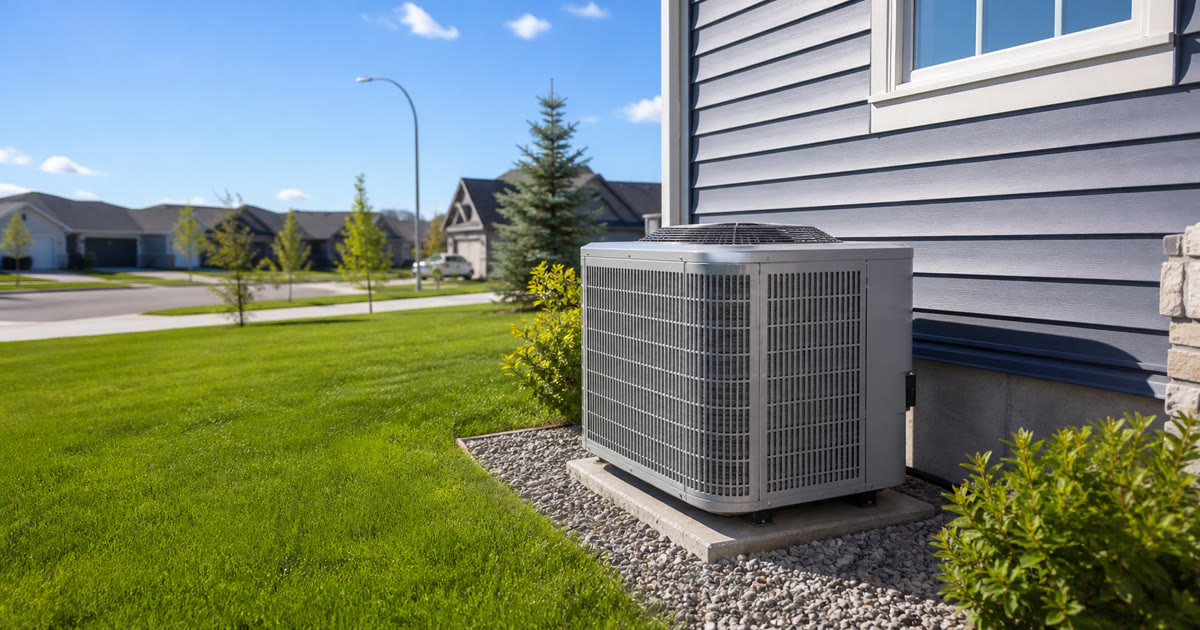
The condenser is the big metal box sitting outside, usually beside the house or on a concrete pad. Outside, it collects everything: cottonwood fuzz, last year's leaves, grass clippings from spring mowing, and a layer of dust that noticeably cuts airflow.
The homeowner's cleaning method:
- Remove any debris on top and around the unit — clear at least 60 cm (2 feet) in all directions. In tight side yards, this might mean trimming back shrubs that grew in over May and June.
- Unscrew the top grille or lift off the fan assembly (most residential units — Lennox, Carrier, KeepRite — have four screws on the top panel).
- Gently spray the coils from the inside out with a garden hose on low pressure. Never use a pressure washer — those fins bend with a hard stare, and a bent fin costs airflow.
- Wipe down the fan blades with a damp rag. Dry, dusty air coats them with a fine layer that throws off the balance.
- Reassemble and check that nothing rattles when you spin the fan by hand.
If the coils are matted with cottonwood fuzz — common in Calgary neighbourhoods like Elbow Park and Mount Royal with mature trees — spray-on coil cleaner (available at any hardware store) helps. Follow the can's instructions, rinse thoroughly, and wait 30 minutes before powering the unit back on.
Step 5: Check the thermostat and test (2 minutes)
- If you have a programmable thermostat, check that it's set to "Cool" and not still in "Heat" mode from winter. You'd be surprised how many service calls start with the thermostat still on heating.
- Set the temperature 3–4°C below room temperature. You should hear the outdoor unit hum to life within a minute and feel cool air from the vents within 3–5 minutes.
- Go outside and listen. A healthy AC unit produces a steady hum; clicking, buzzing that stops after a few seconds, or a fan that doesn't spin often means the capacitor has failed. A capacitor holds a charge even with the power off, so leave the diagnosis and replacement to an HVAC company.
When to call YOFF for AC prep in Calgary
You don't need an HVAC specialist for basic AC prep. Our technician can handle:
- Condensate drain line unclogging — wet-dry vac and proper adapters, done in 15 minutes.
- Coil cleaning — with commercial foaming cleaner and fin combs to straighten bent fins.
- Filter replacement — if the slot is stuck, rusted, or in an awkward basement crawlspace.
- Clearing around the condenser — trimming back shrubs and removing debris so the unit can breathe.
These are routine maintenance jobs and usually cost far less than a dedicated HVAC dispatch.
What NOT to touch (leave to a heating/HVAC company)
- Refrigerant charging. If your AC runs but doesn't cool, the refrigerant charge might be low. Refrigerant work needs specialized equipment and training — it belongs with an HVAC company.
- Capacitor or compressor problems. A failed capacitor or a worn compressor needs an HVAC company. If the outdoor unit makes a grinding noise, clicks without starting or refuses to run at all, stop and book an HVAC service call.
- Evaporator coil leak. If you see oily residue on the indoor coil or smell a sweet, chloroform-like odour, stop and call an HVAC company.
Calgary AC maintenance: timing
When to do it: Early June is ideal in Calgary. By late June, every service provider in town is booked solid and charging peak-season rates. Do your startup now, before the first 30°C day of the summer.
Why it pays off: A routine visit that covers the filter, the condensate line and the outdoor coils costs far less than an emergency HVAC call in the middle of a Calgary heat wave.
Quick reference: AC startup checklist
- Turn off power at the breaker and outdoor disconnect
- Replace or clean the furnace/AC filter
- Pour vinegar down the condensate drain cleanout, then flush with water
- Clear debris around the outdoor condenser (60 cm clearance)
- Gently hose the outdoor coils (inside → out)
- Wipe fan blades, reinstall top
- Set thermostat to Cool, test for 5 minutes
- Listen for odd noises at the outdoor unit
Related Calgary Home Guides
- How to Clean a Ceiling Fan in Calgary: Dust, Wobble and Care
- Dishwasher Not Cleaning? The Calgary Hard Water Fix That Works
- Furnace Humidifier Maintenance in Calgary: Fix Dry Air & Scale
Frequently Asked Questions
When should I turn on my air conditioner for the first time in Calgary?
Early June is ideal. Do the startup checklist before the first 30°C day, while service providers still have openings and before peak-season rates kick in. Starting early also gives you time to fix a clogged drain line or a stuck filter slot without sweating through a heat wave.
How often should I change my furnace filter when the AC is running?
Check it every 30–60 days during heavy cooling season, because the AC uses the same blower and filter as your furnace. A basic 1-inch fibreglass filter should be swapped monthly, while a 4-inch pleated media filter can often last up to three months. Homes with pets or nearby construction dust need more frequent changes.
Why does my AC smell musty when I first turn it on?
A musty smell usually points to a clogged condensate drain line or water sitting in the drip pan after months of disuse. Flushing the line with half a cup of white vinegar and then warm water often clears it. If the smell is sweet or chemical rather than musty, turn the unit off and call an HVAC company.
Can YOFF recharge my AC refrigerant?
No. Low refrigerant, capacitor and compressor problems and coil leaks belong with a heating/HVAC company. Our technician can take care of filter changes, condensate line cleaning and outdoor coil cleaning, which cover most startup problems.
The bottom line for Calgary homeowners
Your air conditioner isn't broken — it just woke up from a long winter with a dirty face and a plugged throat. Half an hour of startup maintenance in early June means it runs quieter, cools faster, and costs less to operate through Calgary's hottest weeks. Skip it, and the unit might still work — but it'll work harder, run longer, and be more likely to fail on the one day you really need it.
If you'd rather have someone else handle the AC prep — or if you tried the checklist and the condensate line won't clear, or the filter slot is rusted shut — YOFF Home Services has you covered. We're a Calgary home services team serving neighbourhoods from Falconridge to Shawnessy. Same-day and next-day calls are available across the city and surrounding communities.
Rather have YOFF handle it?
We cover seasonal and more across Calgary and nearby communities — booked fast, done right. No Fix — No Fee.