Bathroom Faucet Replacement Calgary: What a Swap Involves
A bathroom faucet swap looks simple, and on a good day it is: shut off the water, unhook two lines, drop in the new faucet, test. On a bad day it means a seized nut, a missing shut-off valve and a flooded vanity. Here is what bathroom faucet replacement in Calgary really involves, so you can decide whether to do it yourself or hand it to a technician.
When to replace instead of repair
Not every tired faucet needs to go. A drip from the spout is often a worn cartridge, and that is a cheaper fix. Our guide to replacing a faucet cartridge or the whole faucet explains how to tell the difference.
Replacement usually makes more sense when:
- The finish is peeling, pitted or flaking off.
- The body is corroded or cracked, or it leaks from the base.
- The handles are loose or wobble even after tightening.
- Repair parts for an old or discontinued model are hard to find.
- You are updating the bathroom and want a matching look.
- The faucet is clogged with scale that no amount of soaking will clear.
That last one is common here. Calgary's water is hard, and mineral scale builds up inside faucets over the years. We cover that in how hard water builds up in Calgary faucets.
Check what you have before you buy
The most common mistake is buying a faucet that does not match the sink. Look at the sink (or vanity top) from above and count the holes.
- Single hole. One faucet body with one handle. The easiest to install.
- Centerset (three holes, 4 inches apart). A faucet with the spout and handles on one base plate.
- Widespread (three holes, 6 to 16 inches apart). Spout and two handles are separate pieces.
Count the holes and measure the distance between the outer holes before you shop. A single-hole faucet can often be used on a three-hole sink if it comes with a deck plate, but a widespread faucet will not fit a single-hole sink.
Also check:
- Pop-up drain. Most new faucets include a pop-up assembly. If you reuse the old drain, make sure the new lift rod lines up.
- Spout height and reach. Tall vessel-sink faucets do not suit a standard drop-in sink, and a tall spout can splash on shallow basins.
- Finish. Chrome and brushed nickel hide water spots well. Matte black looks great but shows hard-water marks quickly in Calgary, so plan on wiping it down.
- Water-saving rating. Look for a flow rate marked on the box. Low-flow aerators save water and still feel fine at a bathroom sink.
What a bathroom faucet swap involves, step by step
Here is the usual sequence. Set aside 1 to 2 hours for a first swap, longer if the old faucet fights back.
- Clear the cabinet. Empty the vanity, lay down a towel and put a bucket underneath. Bring a flashlight and a small mirror if the space is tight.
- Shut off the water. Turn the small oval or round valves under the sink clockwise to close the hot and cold lines. If there are no shut-off valves, or they will not turn, you will need to close the main. Our guide to finding the main water shut-off valve in Calgary shows you where to look.
- Open the faucet. Turn it on to drain what is left in the lines and relieve the pressure.
- Disconnect the supply lines. Use an adjustable wrench to loosen the nuts at the valves. A little water will drip out, so keep the bucket handy.
- Remove the pop-up and mounting hardware. Loosen the lift rod nut, disconnect the drain rod and unscrew the mounting nuts under the sink. A basin wrench makes this much easier in a tight cabinet.
- Lift out the old faucet. Clean the sink surface of old sealant and scale so the new faucet sits flat.
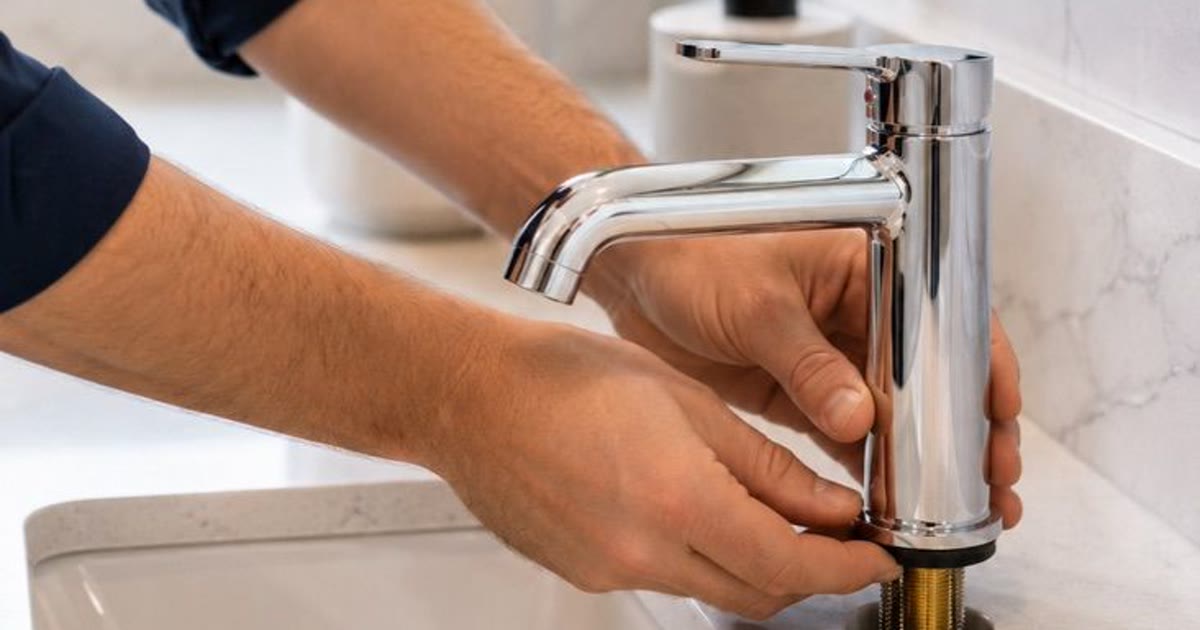
- Install the new faucet. Follow the manufacturer's instructions. Seat the gasket or a thin bead of silicone, drop the faucet through the holes and tighten the mounting hardware from below.
- Connect the supply lines. Hot goes left, cold goes right. Hand-tighten, then give each nut a small turn with a wrench. Over-tightening damages the washers and causes the very leaks you are trying to avoid.
- Flush the lines. Remove the aerator, open the new faucet, then turn the valves slowly back on. Run the water for a minute to flush out debris, then replace the aerator.
- Test for leaks. Run both hot and cold, close the faucet, then check every joint with a dry paper towel. Check again after an hour and again the next morning.
Where swaps go wrong
A few things trip people up, especially in older Calgary houses.
Seized or corroded nuts. In Calgary homes built in the 1960s and 1970s, in communities like Haysboro, Acadia and Brentwood, the mounting nuts and valves may not have been touched in decades. Forcing them can crack the sink or twist the valve. Penetrating oil and patience help, but sometimes a valve has to be replaced too.
Old shut-off valves that do not shut off. If you turn the valve and the water keeps flowing, stop. A valve that has not moved in years can break or leak when you finally use it. Replacing it is a small job, but it needs the main water off.
Flexible supply lines that are too short or too long. Measure the distance from the valve to the faucet inlet and buy lines to match. Also check the connection size at the valve, since compression and threaded fittings are different.
Cramped space. Many vanities sit tight against the wall or floor, and the faucet nuts live in the back corner. A basin wrench and a headlamp are worth the cost.
A pop-up drain that does not seal. If the stopper won't hold water, the rod is usually out of position. If it drains slowly or smells, see our notes on cleaning a bathroom sink stopper.
A Calgary tip: protect your sink and vanity
Most vanities in newer Calgary builds are cabinet-grade particleboard with a stone or cultured-marble top. They hate water. If the replacement leaves a slow drip, the cabinet bottom swells and the finish lifts. Keep a dry towel on the cabinet floor for the first week after a swap, and look at it each day.
Also note that Alberta winters dry out indoor air, and caulk around the faucet base shrinks over time. A fresh bead of silicone around the base once a year keeps water from seeping under the faucet and into the vanity top.
DIY or call a technician?
Doing it yourself is realistic if:
- The shut-off valves work and turn smoothly.
- The new faucet matches the hole layout of the old one.
- You have the basic tools: adjustable wrench, basin wrench, bucket, flashlight and silicone.
- You are comfortable working on your back in a tight cabinet.
Call a technician if:
- The shut-off valves are stuck, leaking or missing.
- The old faucet is corroded to the sink.
- You are installing a wall-mounted faucet or changing the number of holes in the sink.
- You are replacing several faucets (for example, during a bathroom refresh) and want it done in one visit.
- You tried it once and it still drips.
A YOFF technician in Calgary can remove the old faucet, install the new one, replace tired supply lines and test everything before leaving. If a job runs into something we don't handle, such as work inside the wall, we will tell you plainly.
FAQ
How long does a bathroom faucet replacement take? Most swaps take about one to two hours. A seized nut, a stuck valve or a tight vanity can add time, and so can a pop-up drain that needs to be replaced as well.
Do I have to turn off the main water to replace a bathroom faucet? Only if the shut-off valves under the sink are missing or will not close. If they work, you can isolate the sink and leave the rest of the house running.
Can I put a new faucet on my old sink? Yes, if the hole layout matches. Count the holes and check the spacing between them. A single-hole faucet with a deck plate can cover a three-hole sink, but not the other way around.
Should I replace the supply lines at the same time? Usually yes. Old braided lines and rubber washers wear out, and a new faucet is the cheapest time to swap them. It adds little cost and reduces the risk of a leak under the sink.
What if the new faucet drips right after I install it? Check the supply line nuts first, then the aerator, then the faucet base. A drip right after installation is usually a loose connection or a pinched washer, not a defective faucet.
Need a hand?
If you would rather not spend your Saturday on your back in the vanity, YOFF Home Services handles bathroom faucet replacement across Calgary. We bring the tools, swap the faucet, test it and leave the cabinet dry. With our No Fix, No Fee policy, you pay for results. Get in touch for a quick quote.
Rather have YOFF handle it?
We cover faucets and more across Calgary and nearby communities — booked fast, done right. No Fix — No Fee.