Dishwasher Not Cleaning? The Calgary Hard Water Fix That Works
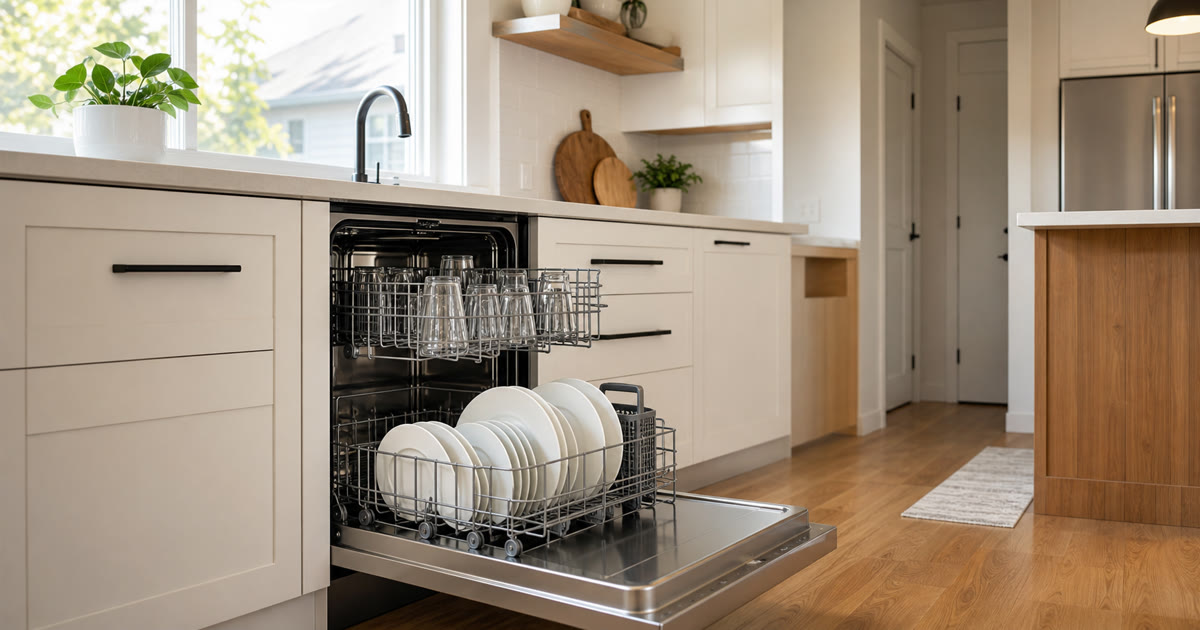
You load the dishwasher, run it, open the door — and there it is: a white haze on your glasses, crumbs still stuck to plates, a faint stale smell. You start wondering if it's time for a new dishwasher. For most Calgary homeowners, the answer is no. The real culprit is likely sitting in your water supply.
Calgary's drinking water — drawn from the Bow and Elbow Rivers and flowing through limestone-heavy terrain — is hard water. The same calcium and magnesium that leave white spots on your shower door are quietly building up inside your dishwasher every cycle. Over time, that mineral crust clogs spray arms, coats the heating element, and turns your appliance into a lukewarm rinse station instead of a cleaning machine.
The fix usually doesn't require a service call. It takes about an hour, costs almost nothing, and restores your dishwasher to near-new performance. Here's exactly what to do.
Why Calgary Water Is So Hard on Dishwashers
To understand what's happening inside your dishwasher, you have to understand what's in your tap water. As it flows from the Rocky Mountain headwaters through sedimentary geology into the city's treatment plants, the water picks up dissolved calcium carbonate and magnesium. By the time it reaches your kitchen tap in Brentwood, Haysboro, or Acadia, it carries enough dissolved minerals to be classed as hard water.
That level of hardness does two things inside a dishwasher when the hot water hits it. First, the heat causes calcium to precipitate out of the water and bond to any surface it can find — spray arms, the heating element, the interior walls, and even your glassware. Second, dishwasher detergent has to work harder in hard water; the minerals essentially consume some of the detergent before it can tackle food and grease.
The result is what almost every homeowner here eventually sees: cloudy glasses with a film you can't wipe off, white residue on black plastic items, and a gradual decline in how clean things come out. The dishwasher isn't broken. It's suffocating under the local water chemistry.
Most Calgary homes, old or new, have no water softener at the point of entry, so the dishwasher takes the full brunt of municipal water hardness day after day.
The Five Signs Your Dishwasher Needs a Deep Clean
Before you open the tool drawer, let's confirm hard water buildup is the problem. Here are the five signs we see most often in Calgary:
- Cloudy glasses with a white film — This is usually a calcium film, not dirt. A quick test: wipe a cloudy glass with vinegar. If the film disappears, it's mineral buildup. If the glass stays cloudy, it may be permanent etching.
- White crust on the heating element — If your model has an exposed heating element at the bottom, open the door after a cycle. It should look silver or dark grey. If it's coated with a white, chalky crust, you've got serious scale buildup.
- Dishes coming out gritty or with food residue — When spray arms clog, water pressure drops. The top rack suffers first because it's furthest from the pump.
- Water sitting in the bottom after the cycle — If the filter is packed with mineral gunk mixed with food debris, water can't drain properly.
- Musty smell that doesn't go away — Scale and trapped food bits create the perfect environment for odour-causing bacteria.
If you check two or more of those boxes, a deep clean will almost certainly fix it. Hard water is predictable — it leaves the same evidence everywhere — so diagnosing the problem is usually straightforward.
The DIY Deep Clean: Step by Step
Set aside about an hour. All you need: white vinegar, an old toothbrush, a soft cloth, and a small bowl.
Step 1: Clean the filter (10 minutes)
Every dishwasher has a filter at the bottom — usually a cylindrical screen with a coarse outer mesh and fine inner mesh. This is ground zero for hard water sediment. Here's how:
- Remove the bottom rack. The filter is in the centre of the floor, often under the lower spray arm.
- Twist it counterclockwise and lift it out. If it hasn't been cleaned in a year or more — common in busy households — it will feel heavy with grey gunk.
- Rinse it under hot tap water. Use the toothbrush to scrub the fine mesh until you can see through it again.
- Soak it in a bowl of warm water and white vinegar (50/50 mix) for 10 minutes while you do the next step. The vinegar dissolves calcium deposits that hot water alone won't touch.
A properly cleaned filter alone often restores noticeable performance.
Step 2: Unclog the spray arms (15 minutes)
The upper and lower spray arms are hollow plastic bars with tiny nozzles. Over months of hard water cycles, those nozzles fill up with mineral scale. Water sprays weakly or not at all from some holes.
- Remove the lower spray arm (usually clips or a single centre screw) and the upper arm (often clips onto the top rack track).
- Hold each arm up to a light and look through the nozzle holes. Any hole that's blocked or half-blocked is a problem.
- Use a toothpick or a thin wire to clear each hole, then rinse the arm under the tap. You'll likely see white grit flush out.
- If the arm feels heavy with trapped water and scale, submerge it in warm vinegar water for 15 minutes — the same 50/50 mix. Shake it underwater to dislodge mineral chunks inside.
With Calgary's hard water, spray arms scale up steadily. Cleaning them twice a year keeps the nozzles open and the spray strong.
Step 3: Descale the interior and heating element (20 minutes active + cycle)
Now for the whole-machine treatment. If your dishwasher has an exposed heating element at the bottom, it bears the worst of the scaling because it's the hottest surface during the wash.
- Make sure the dishwasher is off and cool. Soak a cloth in pure white vinegar and wrap it around the heating element. Leave it for 20 minutes. The acid softens the calcium crust enough that you can scrub it off with the toothbrush.
- Wipe down the door edges, the rubber gasket, and the soap dispenser. Scale builds up in every crevice.
- Finally, place a small bowl of white vinegar upright on the top rack (about 250 ml / 1 cup) and run the hottest, longest cycle with no detergent and no dishes. The vinegar vapour will descale every internal surface you can't reach.
After this cycle, open the door and let it air out. The vinegar smell dissipates quickly. What you'll notice instead: a dishwasher that smells like nothing — exactly what you want.
Preventing Hard Water Buildup: The Calgary Maintenance Routine
A deep clean once or twice a year gets you back to baseline. A few small habits keep you there.
Use a rinse aid. Every dishwasher has a rinse aid dispenser, usually next to the detergent compartment. Rinse aid breaks the surface tension of water so it sheets off dishes instead of drying as mineral spots. With water this hard, this is not optional — it's essential. Fill it once a month.
Add dishwasher salt if your model supports it. Many European-brand dishwashers (Bosch, Miele, Blomberg) have a built-in water softener that uses salt. If your dishwasher has a salt compartment at the bottom, use it. Hard water makes this feature especially valuable. Check your manual to see if your machine has this.
Run a vinegar cycle monthly. Once a month, place a bowl of vinegar on the top rack and run an empty hot cycle. It takes two minutes of your time and keeps scale from getting thick enough to clog the spray arms and filter.
Scrape, don't rinse. Modern dishwasher detergents are enzyme-based and need some food residue to work chemically. Just scrape off large chunks — the detergent handles the rest. Pre-rinsing wastes water and doesn't help with hard water.
When to Call for Help
This guide covers most of the dishwasher complaints we see. But sometimes the issue goes deeper. Stop and get help if:
- Water pools and won't drain after cleaning the filter. That suggests a blockage deeper in the drain line, common in older homes where kitchen drain lines have years of accumulated grease and scale.
- The dishwasher trips the breaker or sparks. Turn it off at the breaker and leave it off — this is a safety issue for an electrician or an appliance repair company.
- You hear grinding or squealing. That's the pump or motor, not a filter problem.
- The heating element stays cold. If dishes come out wet and cold after a cycle even after descaling, the element may have failed under the calcium crust.
In these cases, don't push through — you'll just do more damage. Our technician can clear a blocked dishwasher drain connection or kitchen drain line, and if the machine is beyond saving, install your new dishwasher. Pump, motor and heating element repairs are a job for an appliance repair company.
Related Calgary Home Guides
- Water Softener Maintenance in Calgary: A Hard Water Guide
- How to Descale a Shower Head: Calgary Hard Water Fix
- Calgary Hard Water: How to Stop Calcium from Killing Your Faucets
Frequently Asked Questions
Why are my glasses cloudy after the dishwasher in Calgary?
Cloudy glasses with a film that won't wipe off are usually calcium from Calgary's hard water, not dirt. Cleaning the filter and spray arms, running a vinegar descaling cycle, and keeping the rinse aid topped up usually solves it.
How often should I clean my dishwasher filter?
With hard water, check and rinse the filter every month or two and give the whole machine a deep clean once or twice a year. A monthly empty hot cycle with a bowl of vinegar on the top rack keeps scale from building back up.
Is vinegar safe to use in my dishwasher?
Yes, used as described here: a cup of white vinegar in a bowl on the top rack during an empty hot cycle, or a 50/50 soak for removable parts like the filter and spray arms. Check your owner's manual for any model-specific cautions.
When should I call someone instead of cleaning it myself?
Call for help if water still pools after you've cleaned the filter, the dishwasher trips the breaker or sparks, you hear grinding or squealing, or dishes come out cold and wet after descaling. Those point to a drain, pump, or element problem rather than buildup.
The Bottom Line
Calgary's water is what it is — perfectly safe, good to drink, and hard enough to leave its mark on everything it touches. Your dishwasher was designed to handle it, but only if you help it out a few times a year. Clean the filter. Clear the spray arms. Descale. Use rinse aid. That's the formula that keeps a dishwasher running like new through years of hard Calgary water.
A replacement dishwasher is a real expense. An hour of DIY cleaning costs a splash of vinegar. Before you assume the machine is dead, try the deep clean. Chances are it'll come roaring back — just like nearly every dishwasher that someone took a toothbrush to.
If it doesn't, you know where to find us. YOFF Home Services covers Calgary and the surrounding area — call us to clear a dishwasher that won't drain or to install a new dishwasher properly the first time.
Rather have YOFF handle it?
We cover handyman and more across Calgary and nearby communities — booked fast, done right. No Fix — No Fee.