Hanging Shelves & Mounting a TV: Doing It Safely
A shelf or TV comes down for one reason: it was hung from the drywall instead of from something solid behind it. Half-inch drywall holds almost nothing on its own, so the whole job is really about finding what's behind the wall and choosing the right anchor for it — and in Calgary homes the wall behind that drywall varies a lot by era and neighbourhood. Do that and a flat-screen will outlast the room.
Start by knowing what your wall is made of, because the anchor depends on it.
Know your weight and your wall
Two numbers decide the whole job: how heavy the thing is, and what's behind the drywall. Before you drill, weigh the item (or check its spec — a 55-inch TV runs 13–18 kg, a loaded bookshelf far more) and decide whether you're landing on a stud or floating off the drywall. Everything that follows hangs on those two answers, so don't skip them. A confident guess here is exactly how shelves end up on the floor.
Find the studs first in your Calgary wall
In most Calgary homes the studs are wood, spaced 16 inches apart (some newer builds in the NW and SE run 24). They're your strongest mounting point.
- Run a stud finder along the wall and mark both edges of each stud, then aim for the centre.
- No stud finder? Tap the wall — a solid thud means a stud, a hollow one means empty cavity. Outlets are usually fixed to one side of a stud, which gives you a starting reference.
- Confirm with a small finishing nail before you commit a big hole.
For a TV, you want the mount's lag bolts driven into at least one — ideally two — studs. That alone carries the load.
Pick the right anchor for the wall
When you can't hit a stud, the anchor does the work. Match it to the wall type and the weight:
- Light loads (picture, small shelf, under ~10 kg): plastic expansion anchors are fine.
- Medium loads (heavier shelf, mirror): self-drilling threaded anchors hold far better in drywall.
- Heavy loads off-stud: toggle bolts (the spring-wing kind) spread the load across the back of the drywall and carry the most.
Calgary basements and some additions have concrete or block walls — those need a masonry bit and concrete anchors or sleeve anchors, not drywall hardware.
One anchor is rarely the limit you think it is. Spread the weight across two or more fixings set well apart, and never hang the full load from a single point at the very top of a tall shelf — leverage multiplies the pull on the top anchors.
Mounting a TV without the crash
- Check the mount's VESA pattern matches the holes on the back of your TV before you buy.
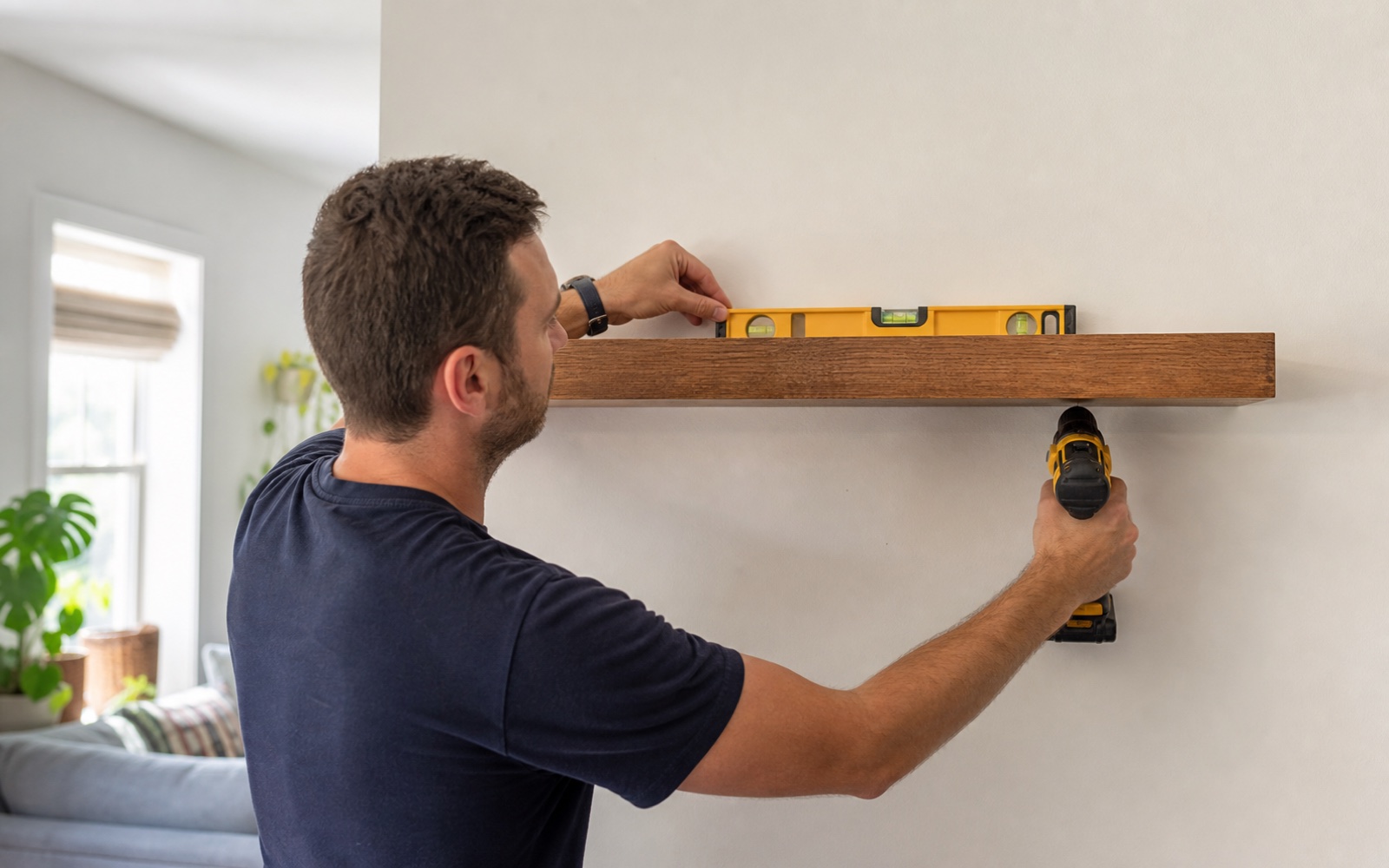
- Mark and level the bracket — measure twice, a tilted TV is obvious from the couch.
- Drive into studs with the lag bolts the mount came with; don't substitute drywall anchors for a TV.
- Hide the cables in a paintable cord raceway, or have an in-wall cable kit run by someone qualified — running power inside the wall is licensed-electrician work in Alberta, not a DIY cable.
- Test the hold with a firm tug before you trust it with the TV.
For floating shelves, the bracket bar must hit studs or heavy anchors — those carry serious leverage when loaded with books.
When to call someone
Most shelf and TV jobs are a confident afternoon. Hand it off when:
- The wall is plaster-and-lath (older Calgary homes) — it cracks unpredictably and needs care.
- You're mounting a large or pricey TV and want it dead-level and stud-anchored with no guesswork.
- You want power or cabling run inside the wall — that crosses into licensed-electrician territory.
If you'd rather it go up once, level, and stay there, YOFF handyman services mount TVs and hang shelves across Calgary with the right anchors for your wall. Get a free quote — No Fix, No Fee.
Rather have YOFF handle it?
We cover handyman and more across Calgary and nearby communities — booked fast, done right. No Fix — No Fee.